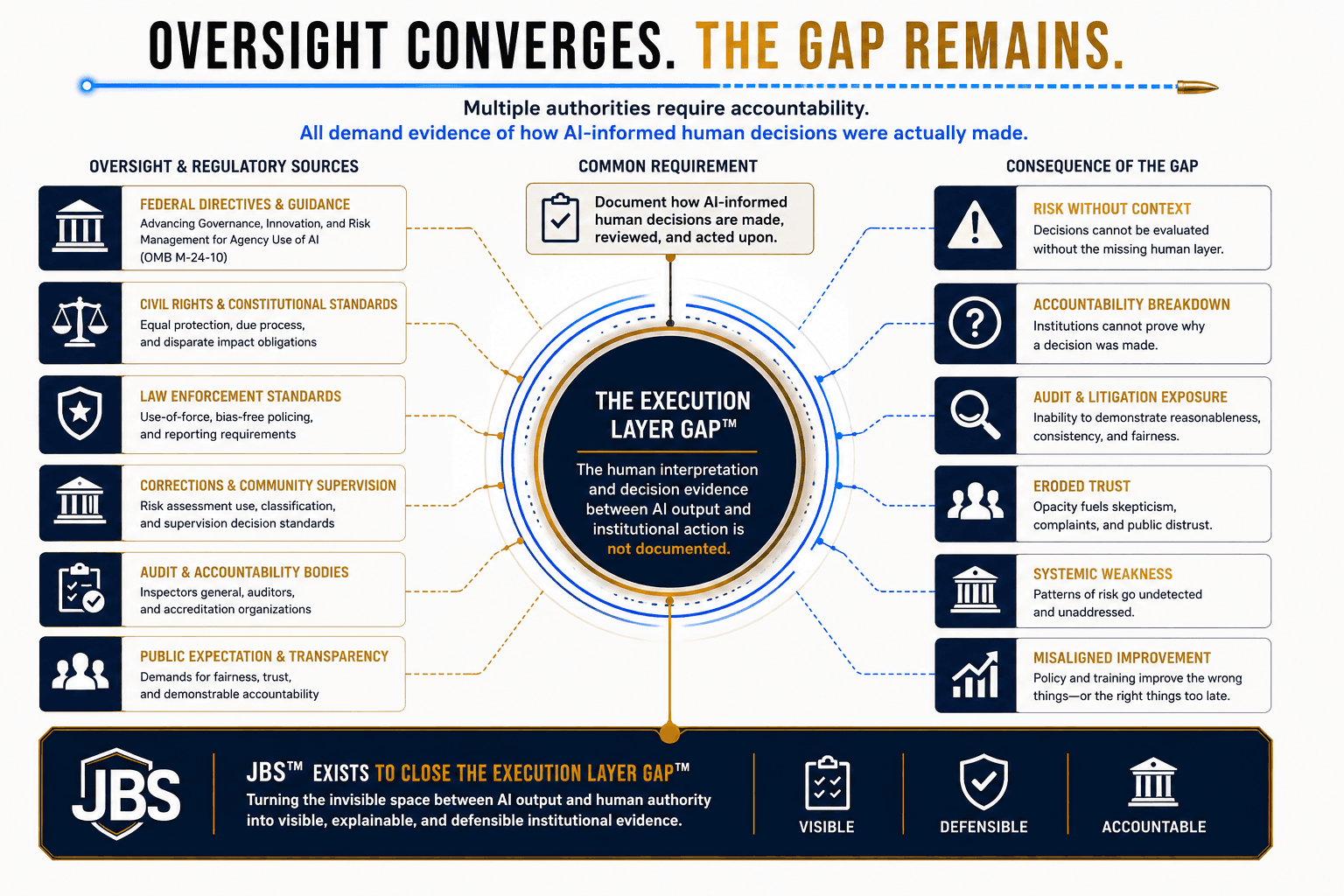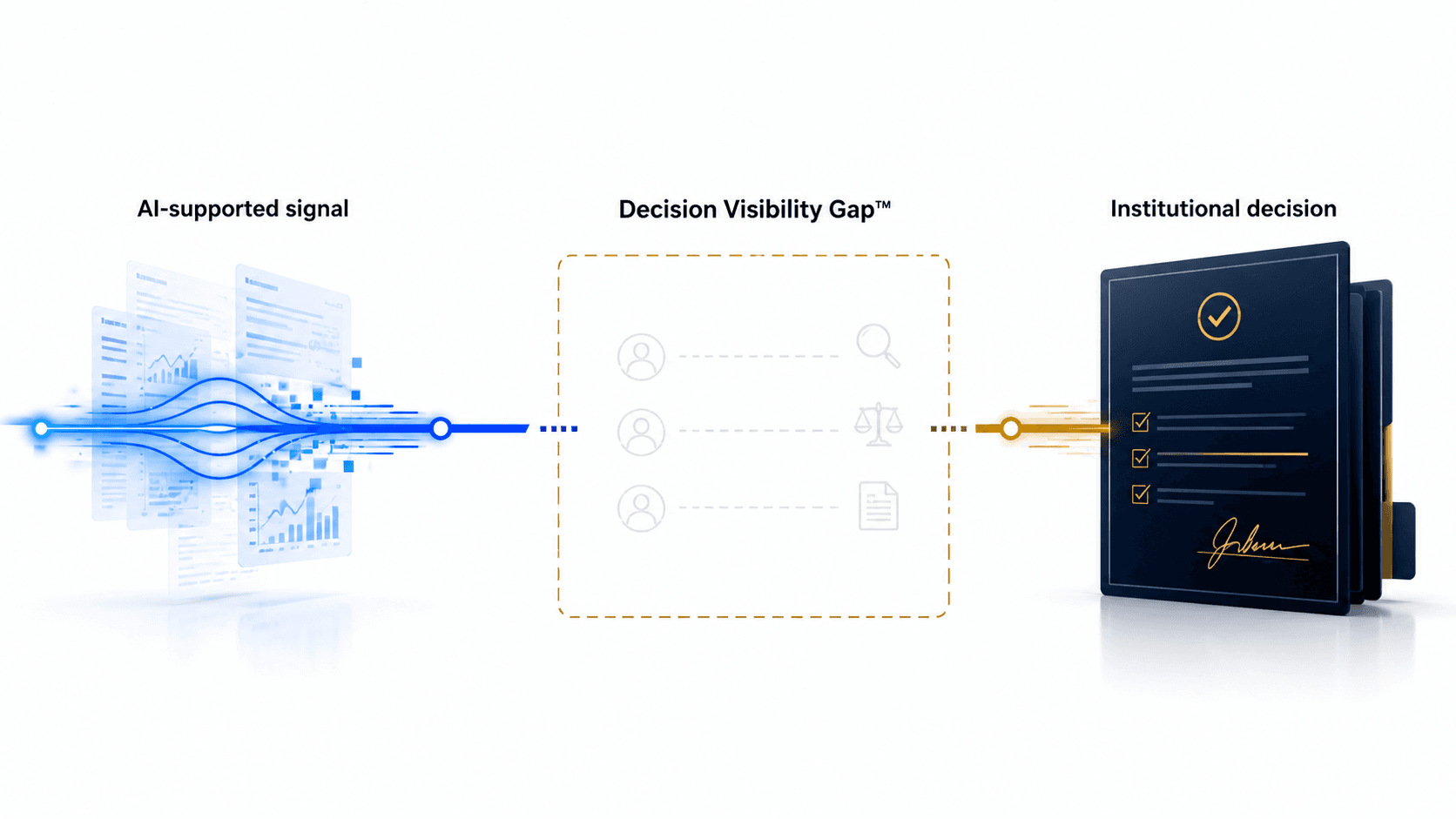
Every federal report, every state bill, every governance framework for AI in criminal justice demands the same thing: meaningful human oversight. Not one of them provides a methodology to verify that human oversight actually occurs. This is the gap Justice Decision Observability was created to fill.
What is accountability theater?
When an agency deploys an AI risk assessment tool, someone checks a box confirming that a human reviewed the output. That checkbox is the entirety of the documentation. It records that a process was followed. It records nothing about what actually happened.
Did the officer read the full output or glance at the score? Did they weigh it against other factors or rubber-stamp it? Did institutional pressure (caseload volume, supervisor expectations, time constraints) shape their response? Did they have the training to meaningfully interpret what the system produced?
None of this is captured. The checkbox says “human reviewed.” The reality is unknown. This is accountability theater: the appearance of oversight without the substance of documentation.
What is driving the demand for governance documentation?
The demand is not hypothetical. Since 2024, federal and state action has created a regulatory environment that explicitly requires what JBS provides:
- The DOJ's December 2024 report on AI and Criminal Justice calls for centralized AI records, staff expertise requirements, higher-risk safeguards, and public engagement mechanisms, but provides no methodology for implementation.
- OMB M-25-21 and M-25-22 (April 2025) require federal agencies to designate Chief AI Officers, establish governance boards, and document vendor compliance, creating compliance mandates with no documentation standard.
- The Council on Criminal Justice Task Force published principles requiring transparent decision-making and meaningful human control of AI, but no framework for measuring whether either occurs.
- California SB 524 (2025) requires disclosure of AI-authored police reports and retention of drafts, the first state-level signal integrity requirement.
- New York A7172 (2025) mandates protocols for AI and facial recognition in investigations, directly implicating post-incident governance review.
The pattern is unmistakable: regulators are mandating governance documentation for AI in criminal justice. No one is providing the methodology to produce it.
Why isn't algorithm auditing enough?
Algorithm auditing answers an important question: Is the AI system fair? Is it accurate? Is it producing biased outputs? Organizations like the Algorithmic Justice League, ORCAA, and BABL AI do essential work answering these questions.
But consider what happens after the audit certifies an algorithm as “fair.” A fair algorithm produces a risk score. A parole officer receives that score. Now what?
Does the officer understand the score? Do they weight it appropriately against other factors? Do institutional pressures (caseload size, time constraints, supervisor expectations) push them toward rubber-stamping? Is there any documentation of what they actually did with the output?
A “fair” algorithm can produce unfair outcomes if the human layer is undocumented. Algorithm auditing examines the system. Justice Decision Observability examines the human. Both are necessary. Neither substitutes for the other.
What are the real-world consequences of this gap?
The consequences are not abstract:
- People are detained because a risk score said “high risk” and no one documented whether the decision-maker engaged meaningfully with that score or simply followed it.
- Sentences are influenced by algorithmic assessments with no governance record of how the judge weighed the assessment against other factors.
- Supervision decisions (home visits, check-in frequency, violation responses) are shaped by automated alerts with no documentation of what the officer did between receiving the alert and acting on it.
- Defense attorneys cannot challenge AI-informed decisions because the human decision layer is completely undocumented. There is no evidence trail to examine.
Every one of these scenarios happens today, in jurisdictions that already deploy AI in their criminal justice systems. The only thing missing is the documentation that would make these decisions transparent, accountable, and challengeable.
The Implementation Gap
The federal government has told agencies what to do. It has not told them how.
Governance failure does not occur at procurement. It occurs at execution. The DOJ report specifies requirements. NIST provides a risk management architecture. State legislatures are passing mandates. But none of these actors have produced a governance documentation methodology, a structured way to record what happens in the space between AI output and human decision.
Justice Beacon Solutions fills this gap. The DCRR™ and CEGR™ are the governance documentation services that turn regulatory mandates into operational reality: proactive documentation for deployed systems, and event-activated reconstruction when governance failures occur. They are the how that the field has been missing.
Next Steps
- Read the full JDO definition : The canonical reference
- Our Services : DCRR and CEGR governance documentation
- The JB-DOF™ Framework : Conceptual architecture
- For Justice Institutions : Governance documentation for deployed AI systems