
Governance Documentation Services
DCRR™, CEGR™, and DRPI™ -- structured governance documentation for AI-supported justice systems.
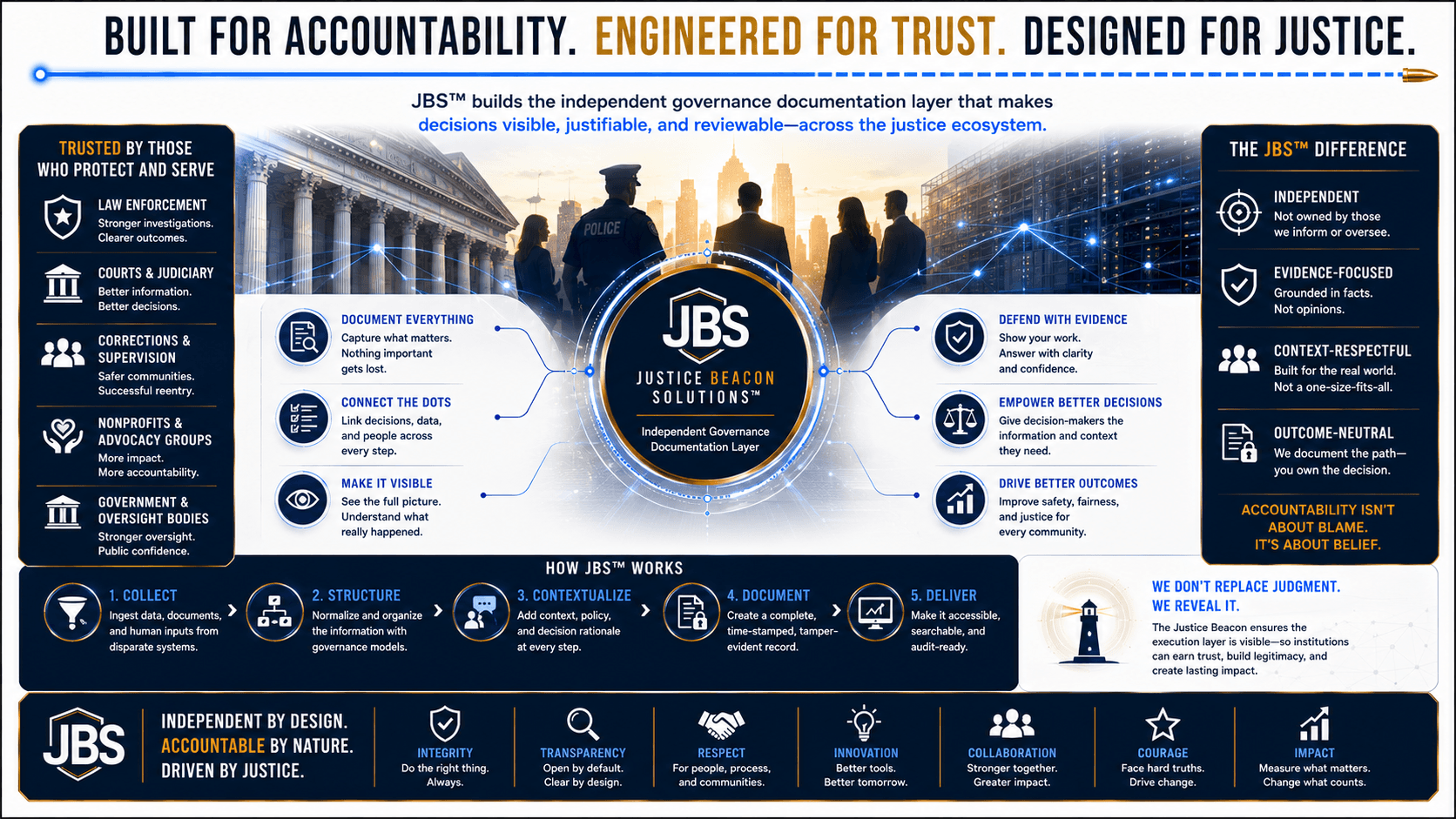
Justice Beacon Solutions™ (JBS) is the originating firm behind Justice Decision Observability™ (JDO™) -- the governance discipline focused on documenting how humans interpret, rely on, and act on AI-supported outputs in justice decision-making environments.
We operate the only governance documentation system built specifically to capture what happens at the execution layer -- the space between what AI systems produce and what humans do with that information.
We do not audit algorithms.
We do not conduct compliance reviews.
We do not assign fault or determine liability.
We document the human decision layer -- making governance visible, explainable, and defensible.
The Decision Visibility Gap™
Most institutions can produce system logs.
Most institutions can produce outcome records.
What almost no institution can produce is documentation of what happened in between -- how staff interpreted an AI-supported signal, what discretion existed, what conditions were present, and why a decision was made.
That undocumented space is called the Decision Visibility Gap™.
It is where most governance exposure lives. It is where oversight inquiries focus. It is where litigation turns. And it is currently absent from the institutional record in almost every justice environment operating with AI-supported systems.
Justice Beacon Solutions exists to close that gap.
The JBS Governance Documentation System
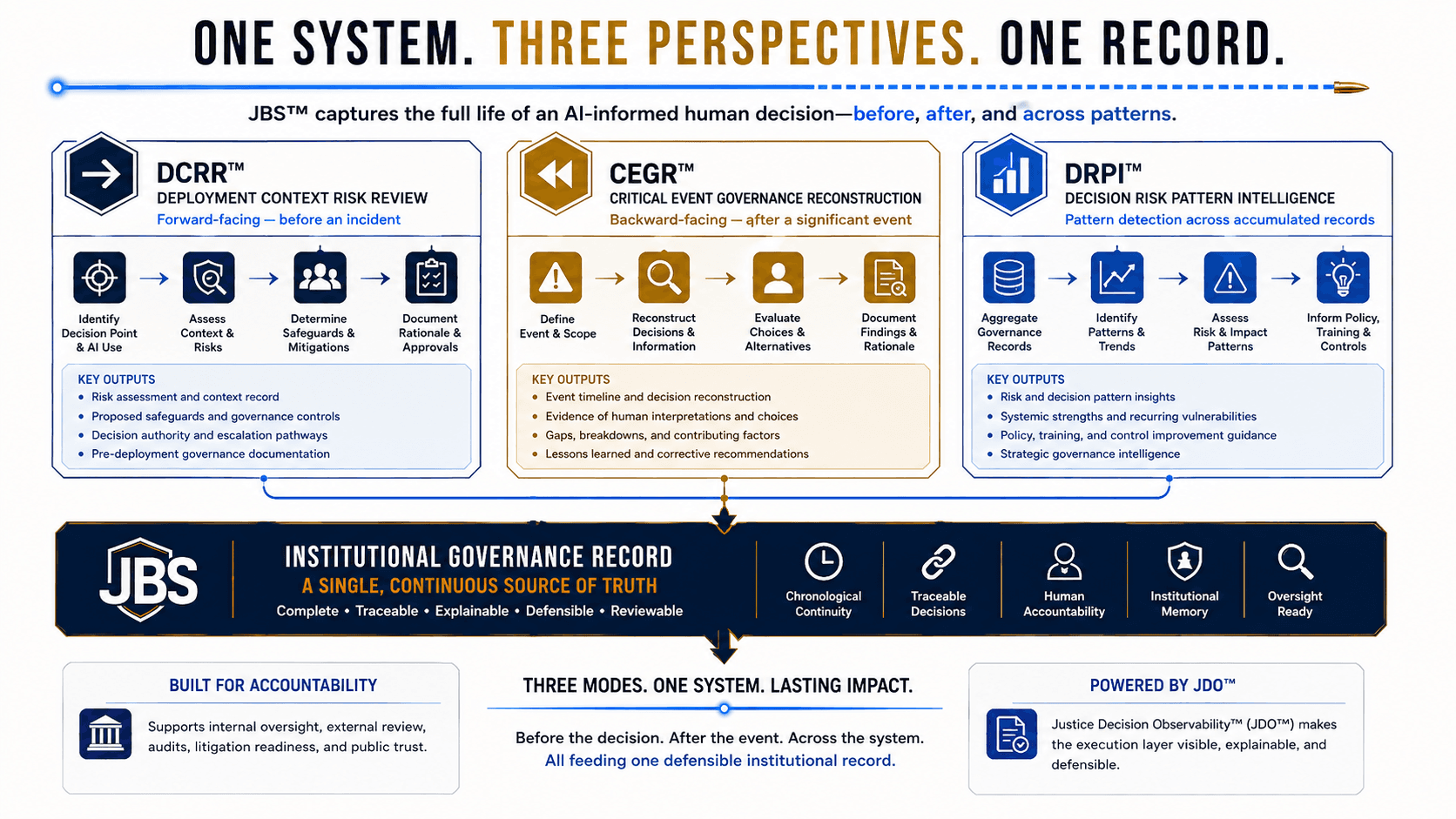
JBS operates a structured governance documentation system built on three proprietary modes of Justice Decision Observability™ -- each addressing a different point in the governance timeline.
Together they produce a complete institutional record of the decision environment surrounding AI-supported outputs.
DCRR™
Deployment Context Risk Review
Forward-facing documentation of how decision environments function in practice
The DCRR™ is conducted before an incident occurs. It provides structured visibility into live decision environments -- documenting the conditions under which AI-supported signals are interpreted, used, and acted upon in real-world operations.
It documents:
- How information is presented and interpreted within decision environments
- How decisions form within operational context
- How institutional conditions, pressure, and discretion influence response and action
- Where governance visibility is strong and where it is limited
This is execution-layer reality -- not system design, not policy review, not compliance checklist.
The DCRR™ produces a documented governance record that institutions can rely on before scrutiny arrives.
CEGR™
Critical Event Governance Reconstruction
Backward-facing reconstruction of decision activity following significant events
The CEGR™ is conducted after a serious incident, complaint, or oversight inquiry. It reconstructs the decision environment that existed at the time -- producing a documented record of what information was available, how it was interpreted, and why the decision occurred.
It documents:
- How AI-supported information was present within the environment at the time of the event
- How decisions formed in response to that information
- How authority functioned within the conditions of the event
- What the institutional record can and cannot currently show
This is governance documentation -- not investigation, not fault assignment, not compliance determination.
The CEGR™ produces the record that makes institutional response defensible.
DRPI™
Decision Risk Pattern Intelligence
Pattern detection across accumulated governance documentation data
The DRPI™ identifies recurring conditions across decision environments -- surfacing systemic governance gaps that are invisible at the individual event level.
It:
- Identifies recurring conditions and decision patterns across populations, units, or time periods
- Highlights areas where governance visibility is structurally reduced
- Surfaces operational drift between policy and practice before it becomes institutional exposure
- Supports movement from reactive governance to proactive governance visibility
The DRPI™ is the pattern layer that transforms individual governance records into institutional intelligence.
How the Three Modes Work Together
DCRR™ documents the decision environment before something goes wrong.
CEGR™ reconstructs the decision environment after something goes wrong.
DRPI™ identifies the patterns that explain why it keeps going wrong.
These are not three separate products. They are three modes of one governance documentation system -- forward, backward, and pattern -- each producing data that feeds the others.
What You Receive
Every JBS engagement produces structured governance records -- the documentation institutions do not currently have and cannot produce from system logs alone.
Governance Memorandum
Primary documentation of decision activity within operational environments
Executive Governance Summary
Leadership-level interpretation of governance conditions -- prepared for senior leadership, legal, and oversight audiences
Governance Condition Statements
Structured articulation of observable system and decision conditions at the execution layer
Oversight Summary
Prepared for legal, compliance, procurement, or external review audiences
Decision Pathway Reconstruction
CEGR engagements -- documented reconstruction of the decision environment surrounding a specific event
Pattern Intelligence Briefing
DRPI engagements -- documented analysis of recurring conditions and systemic governance gaps identified across accumulated decision records
JAOGS™ -- The Governing Standard
Every JBS engagement is conducted within the framework of JAOGS™ v1.0 -- the Justice Automated Operational Governance Standard -- the first governance standard built specifically for justice and corrections environments operating with AI-supported decision systems.
Justice Beacon Solutions serves as the certifying authority for JAOGS™.
The standard defines five certification levels for execution-layer governance environments:
Documented
Traceable
Explainable
Defensible
Certified
Institutions that complete JBS engagements build toward JAOGS™ certification -- establishing a documented, auditable governance record that meets the standard's requirements at each level.
The Governance Infrastructure
JBS operates a proprietary governance documentation infrastructure designed to capture decision environments without accessing client operational data.
The JBS Decision Observability Platform -- currently in development -- will extend this infrastructure into continuous governance visibility across operational environments.
What JBS Is Not
JBS operates in a distinct governance category.
| Not This | This |
|---|---|
| AI auditing | We document human decision-making |
| Compliance consulting | We produce governance records |
| Investigation | We document decision pathways without assigning fault |
| Algorithm testing | We document execution-layer behavior |
| Bias testing | We document how decisions form -- not whether they are biased |
| Software alone | We define and operationalize governance documentation |
| Traditional AI governance | We govern the execution layer beneath AI governance structures |
Who Uses JBS
JBS serves organizations where AI-supported systems shape high-stakes decisions about people:
- Corrections agencies and reentry programs
- Courts and pretrial services
- Public defender offices and legal aid organizations
- Oversight bodies and monitoring entities
- Technology vendors seeking governance documentation support for client deployments
- Foundations and funders evaluating governance readiness in grantee organizations
Ready to Discuss Your Needs?
JBS provides initial consultations to assess governance documentation requirements and identify the right approach for your environment. Engagements are fixed-scope, time-bounded, and designed to produce defensible governance records from the first deliverable.