
The Justice Beacon Doctrine Framework™ (JB‑DOF™)
The first defined measurement standard for decision governance at the execution layer.
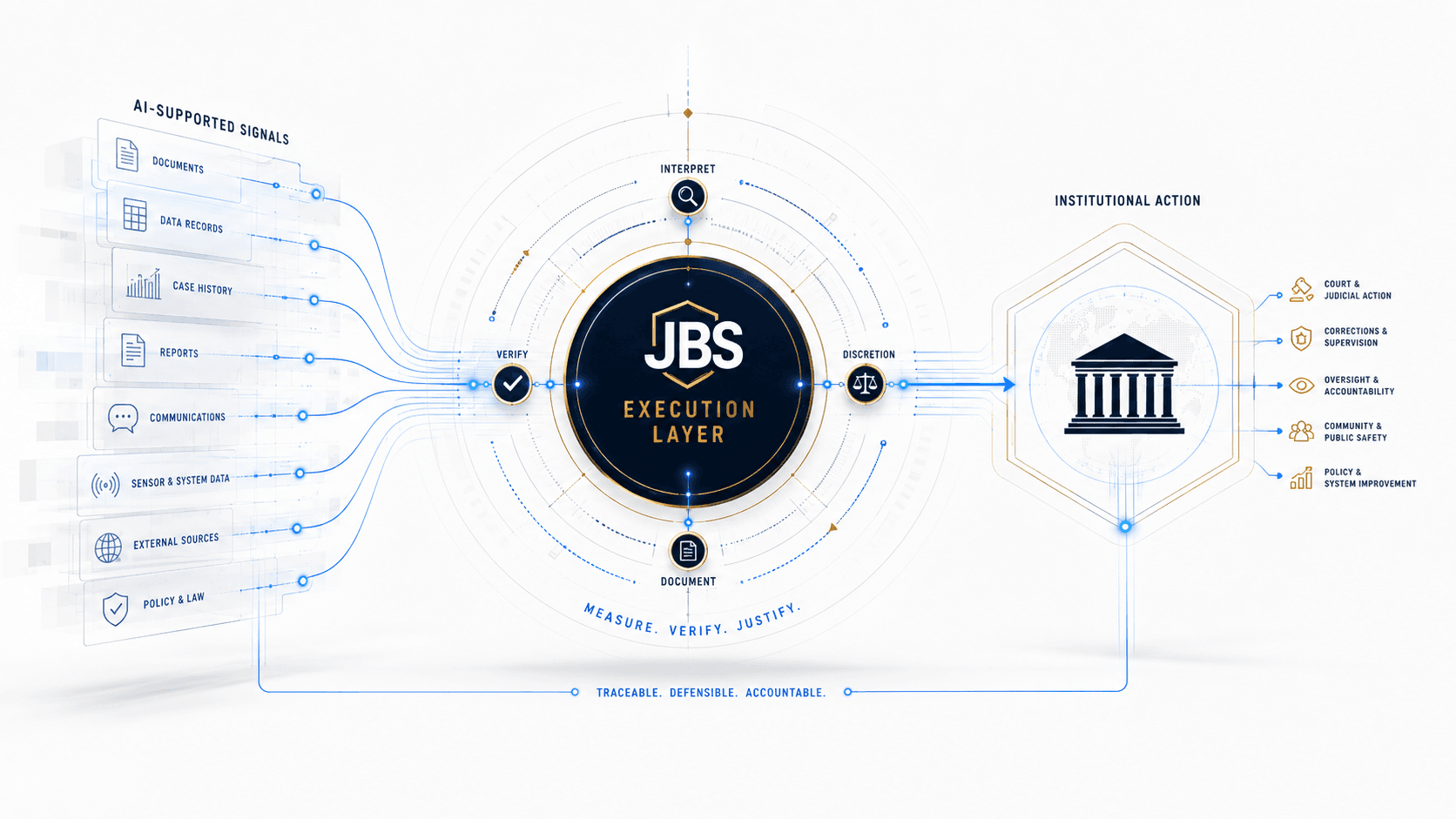
Before JB-DOF™ existed, there was no structured way to evaluate how decisions actually form in AI-supported justice environments. Regulators had defined what oversight should look like. No one had defined how to measure whether it was happening.
JB-DOF™ is that measurement standard. It establishes how decision-making is evaluated, documented, and governed at the execution layer -- the space where automated outputs meet human authority, and where accountability either exists or it doesn't.
Why It Exists
Institutions operating with AI systems are expected to demonstrate oversight. They have been given no standard for doing so.
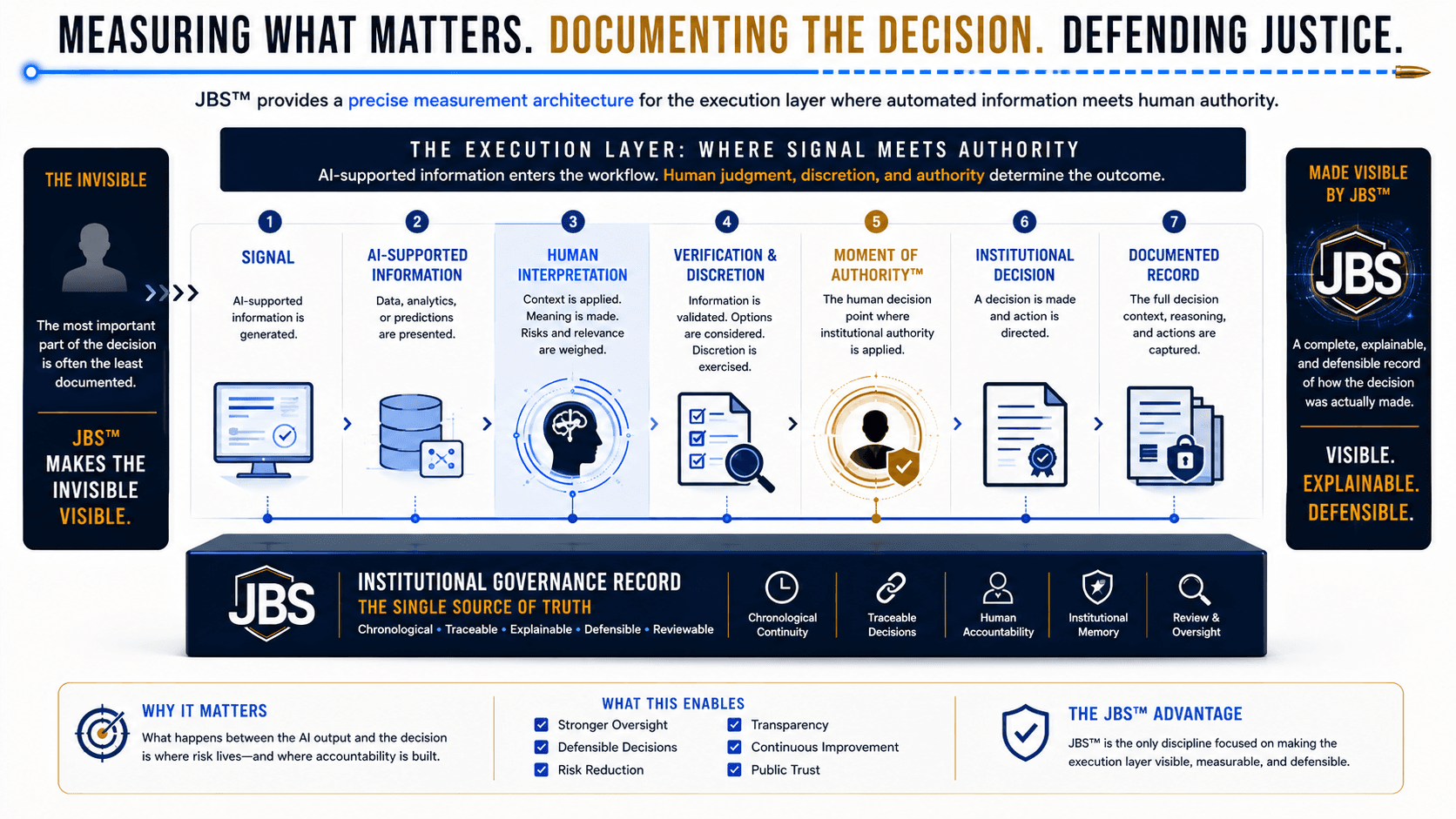
Policies define intent. Audits confirm presence. Neither captures how decisions actually form in practice -- what information was weighted, what authority was exercised, what happened in the moment between system output and human action.
JB-DOF™ defines that moment. It gives institutions the measurement architecture to document decision governance in a form that is consistent, defensible, and repeatable.
What It Measures
JB-DOF™ defines the conditions, pathways, and risk factors present in any decision environment where AI-supported outputs influence human authority. Specifically, it establishes:
- What must be measured in environments where automated outputs meet human decision-making
- How governance conditions are identified -- the structural factors that determine whether meaningful oversight is possible
- How decision pathways are evaluated -- the sequence of information, authority, and action that produces an outcome
- How execution-layer risk is documented -- in a form that survives scrutiny, supports review, and creates an institutional record
This transforms decision governance from a stated obligation into an operational standard with defined criteria.
The Governance Stack
Decision governance operates as a layered system. Each tier defines a distinct function. Together, they constitute the complete JBS architecture.
JDO™
Justice Decision Observability
The Category
Defines the field of decision governance
JB-DOF™
Justice Beacon Doctrine Framework
The Measurement Standard
Defines how decision governance is evaluated
JAOGS™
Justice Automated Operational Governance Standard
The Governing Standard
Ensures consistency, defensibility, and repeatability
ODI™
Operational Decision Infrastructure
The Operational Infrastructure
Enables structured visibility, connection, and documentation of decision environments
Deployment / Event Review
The Documentation Layer
Deployment-Level: how decision environments function | Event-Level: decision activity following significant events
Pattern-Level Insight
The Pattern Layer
Identifies recurring conditions across decision environments
Stack (vertical) = how the system operates
What We Created
JDO™Justice Decision Observability
The new category for governing decision environments across justice systems.
How It Is Structured
JAOGS™Justice Automated Operational Governance Standard
The governance standard that structures this work.
How It Functions
ODI™Operational Decision Infrastructure
The applied infrastructure that makes decision environments visible in real-world operations.
How We Document Decisions
Deployment + Event-Level Review
Structured documentation of how decisions form in practice and how they behave following significant events.
How We Identify Recurring Conditions
Pattern-Level Governance Insight
Identifies recurring conditions across decision environments before they compound.
Where It Operates
JB-DOF™ has a singular focus: how decisions form between system output and human authority.
It is designed for environments where AI-supported tools influence consequential outcomes -- risk assessments, supervision determinations, investigative decisions, sentencing recommendations -- and where the institutions responsible for those outcomes have no current mechanism for documenting how they were reached.
From Framework to Execution
JB-DOF™ defines what must be measured. JBS applies that measurement through three proprietary modes of Justice Decision Observability™:
DCRR™ — Deployment Context Risk Review
Forward-facing documentation of how decision environments function in practice. Used to establish governance baselines, assess operational conditions, and create the institutional record that oversight requirements demand.
CEGR™ — Critical Event Governance Reconstruction
Backward-facing reconstruction of decision activity following significant events. Used when outcomes are questioned, reviewed, or litigated -- and a record of how decisions were made is required but doesn't exist.
DRPI™ — Decision Risk Pattern Intelligence
Pattern detection across accumulated governance documentation. Used to identify structural gaps that single-event review cannot surface.
These are not separate products. They are three modes of the same discipline -- applied forward, backward, and at scale.
The JDO™ Canon: Synthesis Layer
The framework is grounded in a formal body of published work. The Canon's synthesis layer defines the real-world consequences of what JB-DOF™ measures -- specifically, what happens when the execution layer goes undocumented.
These three works establish the stakes:
JDO-2026-015
What Happens After the Signal
The Missing Layer in AI-Supported Decision-Making
JDO-2026-016
The Moment of Authority
Where Human Judgment Becomes Institutional Action
JDO-2026-017
When the Alert Was Seen but Nothing Happened
Decision Failure at the Moment of Authority
The full JDO™ Canon -- the complete body of work establishing the field, architecture, methods, and standards of decision governance -- is available on the Publications page.
JDO™ is not a model. It is a defined operational discipline.
The JAOGS™ Governing Standard
The Justice Automated Operational Governance Standard™ provides the governing architecture that runs beneath every JBS engagement. JAOGS™ ensures that decision governance documentation is produced under consistent criteria -- making outputs defensible, comparable, and reproducible across institutions, jurisdictions, and review contexts.
JB-DOF™ is the standard. Justice Beacon Solutions™ is the only entity that applies it.
Go Deeper
- Why This Matters -- The decision visibility gap and the regulatory environment driving demand
- Our Services -- How DCRR™, CEGR™, and DRPI™ are deployed
- Who We Serve -- Institutions operating with deployed AI systems
- Publications -- The JDO™ Canon and JAOGS™ standards