
About Justice Beacon Solutions

Leadership

Stephanie L. Fleming, PhD, MS, is the founder and principal of Justice Beacon Solutions, LLC and creator of Justice Decision Observability™ (JDO™).
Her work grew from a simple but important question: When technology informs a high-stakes decision, can we clearly show what the human did with that information and why?
Stephanie brings more than 28 years of experience across behavioral health, corrections, academia, research, and justice-system operations. She has worked as a licensed mental health therapist, psychology professor, correctional practitioner, and researcher. She also brings the perspective of someone who has personally experienced the justice system.
Those experiences shaped how she sees institutional decision-making -- not simply as a matter of policy or technology, but as a human process involving judgment, discretion, pressure, and accountability.
Grounded in social psychology and the study of human behavior, Stephanie founded Justice Beacon Solutions to make that human decision layer more visible, explainable, and defensible. Her work has since developed into the broader Justice Decision Observability™ governance architecture for AI-supported and high-stakes decision environments.


Janna M. Broaddus is the Director of Operations at Justice Beacon Solutions, LLC and a co-author of foundational work advancing Justice Decision Observability™ (JDO™).
Janna brings a deeply personal perspective to the work of JBS. As a justice-impacted professional, she understands firsthand how institutional decisions, policies, and systems can shape the course of a person’s life. Her own journey of rebuilding has given her a strong commitment to making justice systems more transparent, accountable, and responsive to the people affected by them.
Her professional experience includes working directly with individuals navigating reentry, recovery, substance use, behavioral health challenges, and the lasting effects of incarceration. These experiences have allowed her to see justice systems from multiple sides -- from the people making decisions to the people living with their consequences.
At JBS, Janna brings that lived and professional experience into the development of practical governance approaches that recognize something often overlooked: behind every high-stakes decision is a human being, and on the other side is often a human life affected by it.
Why JBS Exists
AI produces signals. Humans exercise authority.
What happens between those two moments is rarely documented.
Every framework for “responsible AI” assumes that human oversight is visible and verifiable. It is not.
Governance does not fail at procurement. It fails at execution -- when a decision is made and no record exists of how it formed.
Justice Beacon Solutions exists to document that moment.
The Governance Gap
AI systems generate outputs. Human decision-makers interpret them. Institutional authority produces the outcome.
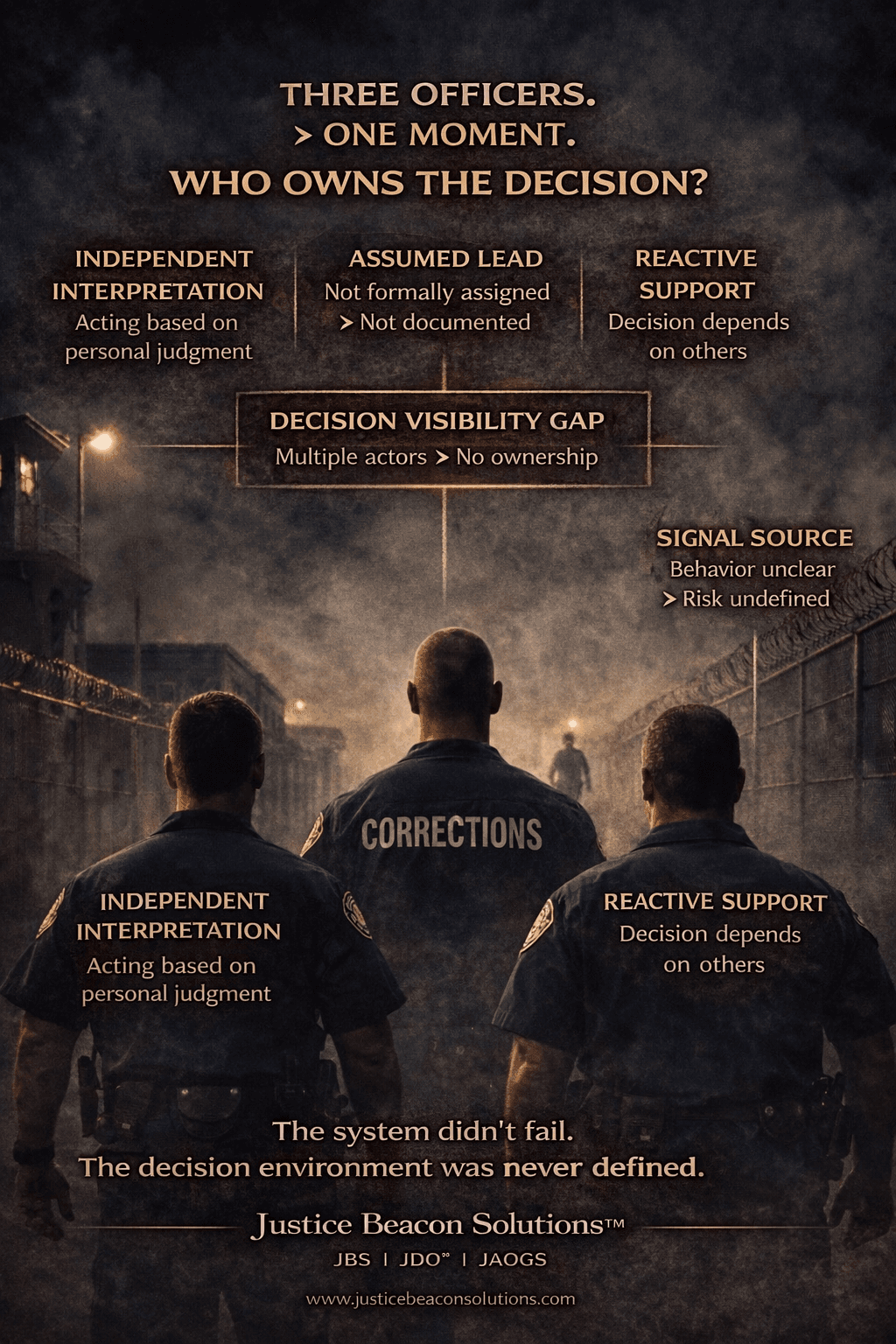
The space between those steps is undocumented in most justice environments. That is the governance gap.
See Why This Matters for the full regulatory picture driving this.
What We Do
Justice Beacon Solutions documents how decisions form in real-world environments where AI influences human judgment.
We document the pathway between:
- system signal
- human interpretation
- exercised authority
- institutional action
This work is defined through Justice Decision Observability™ (JDO™) -- the discipline focused on making execution-layer decision-making visible, documentable, and governable in practice.
What We Do Not Do
JBS operates within a clearly defined boundary:
- We do not audit algorithms
- We do not evaluate system performance
- We do not assign fault or conduct investigations
- We do not produce compliance reports
We document how decisions are made.
How Our Work Is Different
JBS operates at the execution layer.
Our work is:
- descriptive, not evaluative
- independent, not embedded
- observational, not prescriptive
We document what happens -- not what should have happened.
This distinction is what makes governance documentation credible, defensible, and usable across legal, operational, and oversight contexts.
Why Institutions Trust JBS
No commercial relationship with technology vendors
No role in system procurement or evaluation
No incentive to influence outcomes
Independence is the foundation of defensibility.
If a decision cannot be documented, it cannot be explained.
If it cannot be explained, it cannot be defended.
Advisory Board

Troy Richard Carr
Technology & Digital Strategy Advisor
Troy Carr advises Justice Beacon Solutions on digital infrastructure, platform architecture, and AI-native visibility strategy. He is the principal of The Midnight Garden, a technology consultancy serving justice-adjacent and mission-driven organizations.
LinkedInAdditional advisory board members spanning criminal justice administration, defense law, AI governance, and justice-impacted community leadership will be announced in 2026.